
Air Source Heat Pump Regulations UK (2026): Planning Permission, Noise Rules & Legal Requirements Explained
- Ash Sethi
- May 30
- 9 min read

Quick Summary
Air source heat pumps are heavily regulated in the UK to ensure safe installation, proper noise control, and compliance with planning laws. Most residential systems can be installed under permitted development rights, but homeowners still need to follow strict rules involving:
Noise limits (MCS 020 standards)
Boundary distance requirements
Planning permission exceptions
Building Regulations compliance
Property-specific restrictions
This guide explains UK air source heat pump regulations in simple terms using real installation experience, government-backed guidance, and practical homeowner advice.
Introduction: Air Source Heat Pump Regulations UK
Installing an air source heat pump in the UK is not just a technical upgrade — it involves planning rules, noise limits, and legal requirements that many homeowners overlook.
The good news? Most homes can install a heat pump without planning permission — but only if strict conditions are met.
In this guide, we break down UK heat pump regulations for 2026 in simple terms, including planning permission rules, noise limits, building regulations, and the most common mistakes that lead to complaints or rejected installations.
Many homeowners also search for terms like heat pump legal requirements UK, heat pump installation rules UK, and air source heat pump restrictions UK when trying to understand what is actually allowed before installation.
In simple terms, most rules focus on noise limits, placement, and compliance with permitted development — not banning installations outright.
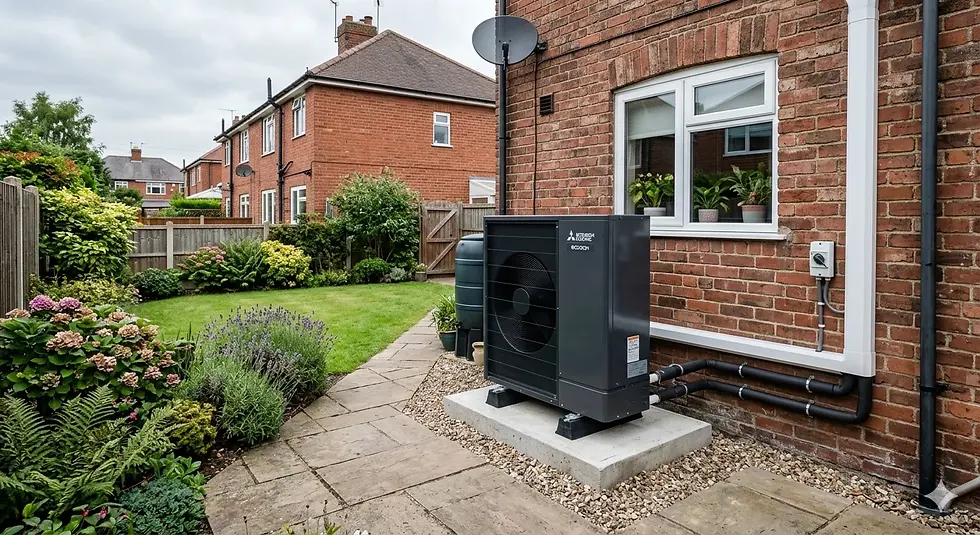
Do You Need Planning Permission for an Air Source Heat Pump?
In many UK homes, air source heat pumps can be installed without full planning permission under permitted development rights.
However, this only applies if the installation meets specific government conditions.
Most compliant domestic installations do not require formal planning approval when:
The unit meets MCS 020 noise limits
The system is correctly positioned
Only one outdoor unit is installed
The property is not restricted by special planning conditions
Properties located in conservation areas, listed buildings, or flats may require additional permissions.
This is why many people ask: can I install a heat pump in my garden UK? — and the answer depends on placement, boundary distance, and noise compliance rather than just location alone.
Can I Install a Heat Pump in My Garden in the UK?
Yes — in most cases, you can install a heat pump in your garden under permitted development rules, provided the system meets noise limits, boundary distance requirements, and installation standards.
However, placement must still comply with air source heat pump restrictions UK, including airflow clearance, neighbour impact, and proper positioning.
Installing a unit too close to a boundary, enclosed in a tight space, or facing neighbouring windows may lead to noise issues or planning complications.
UK Heat Pump Permitted Development Rules (Key Requirements)
For most residential installations in England, these are the main permitted development requirements homeowners need to know.
Key Air Source Heat Pump Rules UK
Only one air source heat pump outdoor unit is permitted
The unit should generally be positioned at least 1 metre from the property boundary
Installation must comply with MCS 020 noise standards
The outdoor unit must not be installed on a pitched roof facing a highway
The system should not visually dominate the property
Installation must comply with UK Building Regulations Part L and Part P
The unit should be installed by qualified professionals following MCS standards
These conditions form the core of heat pump installation rules UK, ensuring systems are safe, efficient, and compliant without requiring full planning permission.
Failure to follow these conditions may require full planning permission.
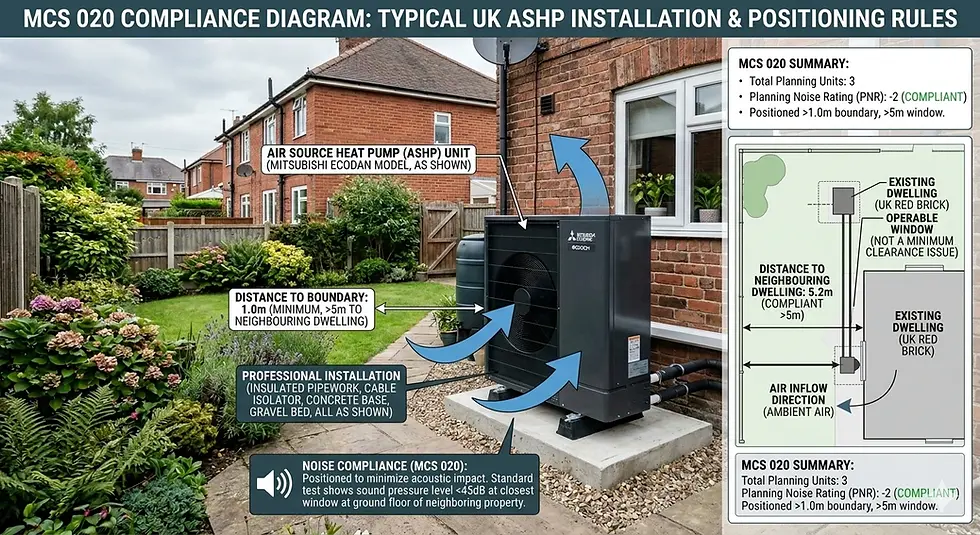
Air Source Heat Pump Noise Regulations UK
Noise is one of the most important parts of UK heat pump regulations.
Modern air source heat pumps are significantly quieter than older systems, but poor positioning can still create neighbour complaints.
What Is the UK Noise Limit?
Most installations must comply with:
MCS 020 Noise Assessment Standards
Approximate limit: 42 dB at the nearest neighbouring window
Noise calculations consider:
Distance from neighbouring properties
Outdoor unit placement
Fan direction
Wall reflection
Operating sound pressure levels
What Causes Noise Complaints?
In many UK installations we review, noise complaints are usually caused by poor positioning rather than the heat pump itself.
Common issues include:
Installing the unit too close to a neighbour’s bedroom
Mounting directly onto weak wall structures
Restricted airflow causing fan strain
Incorrect anti-vibration setup
Correct design and positioning usually prevent these problems entirely.
What Is the Noise Limit for Heat Pumps in the UK?
The typical permitted development noise limit for air source heat pumps in the UK is around 42 dB at the nearest neighbouring window, based on MCS 020 noise assessment calculations.
This limit helps ensure installations do not cause disturbance to nearby properties and is a key requirement for avoiding planning permission.
Poor placement is one of the main causes of noise complaints — read our guide on why heat pumps can be noisy in UK homes for a deeper breakdown.
Air Source Heat Pump Building Regulations UK
Air source heat pumps must comply with multiple UK building regulations.
These regulations ensure:
Electrical safety
Energy efficiency
Structural safety
Proper drainage
Safe refrigerant handling
Key Building Regulation Areas
Part L – Energy Efficiency
The installation must meet minimum energy efficiency requirements and proper system design standards.
Part P – Electrical Safety
All electrical work must comply with UK electrical safety regulations.
Drainage & Condensate Management
Heat pumps produce condensate water during operation and defrost cycles.
Poor drainage design can cause:
Ice buildup
Slip hazards
Winter drainage freezing
Water damage
Structural Positioning
Wall-mounted systems require structurally suitable mounting points capable of handling vibration and weight safely.
Air Source Heat Pump Location Requirements
Correct location selection is critical for both efficiency and regulation compliance.
Ideal Placement Considerations
A properly positioned outdoor unit should have:
Good airflow clearance
Adequate distance from neighbouring windows
Stable mounting surface
Safe drainage path
Minimal airflow obstruction
Easy maintenance access
Locations That Often Cause Problems
Avoid:
Tight enclosed spaces
Direct bedroom-facing placement
Poor ventilation corners
Areas prone to snow blockage
Improperly enclosed decorative housings
Restricted airflow reduces efficiency and increases defrost frequency during winter.
Many air source heat pump restrictions UK are directly linked to installation location, airflow clearance, and proximity to neighbouring properties.
Do Local Councils Have Different Heat Pump Rules?
Yes — local planning authorities can apply additional restrictions depending on the property location.
Rules often vary for:
Conservation areas
Listed buildings
Flats and apartments
Shared residential developments
High-density urban housing
Some councils may request:
Additional noise documentation
Visual impact assessments
Formal planning approval
Neighbour consultation
Always check local planning guidance before installation.
What Happens If You Ignore Heat Pump Regulations?
Ignoring heat pump legal requirements UK can lead to enforcement action, system relocation, or loss of eligibility for government grants.
Non-compliant installation can create serious long-term problems.
Possible Consequences
Planning enforcement notices
Required relocation or removal
Neighbour disputes and complaints
Rejected grant applications
Loss of permitted development rights
Insurance complications
Reduced system efficiency
In many cases, correcting a poorly positioned installation costs significantly more than proper planning from the start.
Air Source Heat Pump Installation Compliance Checklist (UK)
Before installation, homeowners should verify the following:
Compliance Checklist
Meets MCS 020 noise limits
Correct boundary clearance achieved
Proper airflow clearance available
Winter condensate drainage designed correctly
Installation complies with Building Regulations
Outdoor unit positioned safely
System sized correctly for property heat loss
Planning permission requirements checked
Installed by qualified MCS-certified professionals
Eligible for Boiler Upgrade Scheme requirements
This checklist helps reduce installation risks and improves long-term system performance.
Incorrect system sizing is one of the most common causes of noise and efficiency issues — Read our guide on heat pump sizing for UK homes to understand proper system design.
Expert Insight: Real UK Installation Experience
In many UK installations we inspect, planning issues are rarely caused by regulations themselves.
Most problems begin during early design decisions:
Incorrect unit placement
Ignoring airflow requirements
Underestimating neighbour proximity
Poor drainage planning
Choosing the wrong system size
Well-designed installations usually pass planning and noise requirements without major issues.
Homes with proper insulation, realistic heat-loss calculations, and correct positioning consistently achieve better efficiency, quieter operation, and fewer long-term maintenance problems.
Common Myths About Heat Pump Regulations
Myth | Reality |
Heat pumps always require planning permission | Many residential systems qualify under permitted development |
Heat pumps are too noisy for residential areas | Modern systems are designed to meet strict UK noise standards |
Older homes cannot install heat pumps | Many older properties can qualify with proper upgrades |
Any installer can legally install a heat pump | Grant-supported systems require qualified MCS-certified installers |
Noise complaints are unavoidable | Most issues result from poor positioning, not the technology itself |
Are Heat Pumps Legal Everywhere in the UK?
Air source heat pumps are legal throughout the UK, but installation rules vary depending on:
Property type
Planning restrictions
Local authority regulations
Conservation status
Noise compliance
The majority of residential homes can legally install a compliant air source heat pump system.
Compliance & Official Standards
All guidance in this article aligns with UK regulatory frameworks including:
Always consult a certified installer for property-specific compliance.
These standards are used across the UK to assess installation safety, performance, and legal compliance for domestic heat pump systems.
Frequently Asked Question (People also Ask)
Do air source heat pumps need planning permission in the UK?
Most air source heat pumps in the UK do not require planning permission because they fall under permitted development rights, as long as the installation meets noise limits, placement rules, and compliance standards.
However, planning permission may still be required for flats, listed buildings, conservation areas, or installations that do not meet permitted development conditions.
What is the minimum distance for a heat pump from a neighbour?
In the UK, air source heat pumps are typically installed at least 1 metre away from the property boundary, but the exact distance depends on noise calculations, unit size, and positioning.
Proper placement is essential to meet MCS 020 noise regulations and avoid neighbour impact.
What are MCS 020 noise standards?
MCS 020 is the UK noise assessment standard used to determine whether an air source heat pump installation complies with permitted development noise limits.
It evaluates sound levels based on distance, location, and surrounding conditions to ensure the system does not cause disturbance to neighbouring properties.
Can I install a heat pump without an MCS-certified installer?
To qualify for government grants such as the Boiler Upgrade Scheme (BUS), air source heat pumps in the UK must be installed by an MCS-certified installer.
While private installations may still be possible without MCS certification, they may not meet compliance standards or qualify for financial incentives.
Can neighbours complain about heat pump noise?
Yes — neighbours can complain about heat pump noise if the system is poorly installed, incorrectly positioned, or exceeds acceptable noise levels.
Most complaints are caused by installation issues such as boundary placement, vibration, or sound reflection rather than the heat pump itself.
Are heat pumps allowed in conservation areas?
Yes, air source heat pumps are allowed in many conservation areas in the UK, but additional planning restrictions may apply.
Homeowners may need approval from the local planning authority depending on visual impact, placement, and property classification.
Do heat pumps need building regulations approval?
Yes, air source heat pump installations in the UK must comply with building regulations, including electrical safety (Part P), energy efficiency (Part L), and proper system installation standards.
Compliance is essential for safety, performance, and eligibility for government grants.
Solar Panels, Grants & Related Regulations
Many homeowners combining renewable systems also research:
Heat pump grants UK
Solar panel and heat pump packages
Boiler Upgrade Scheme eligibility
Heat pump sizing regulations
Heat pump noise problems UK
Proper compliance improves eligibility for:
Boiler Upgrade Scheme (BUS)
MCS certification requirements
Renewable energy funding support
For full eligibility details, read our guide on Boiler Upgrade Scheme (BUS) requirements in the UK.
About Air Source Company
Air Source Company provides professional air source heat pump consultation, installation support, and compliance guidance across the UK.
The company specializes in:
Heat pump system design
Regulatory compliance checks
Noise assessment guidance
Heat-loss calculations
Air source heat pump troubleshooting
Boiler Upgrade Scheme support
Every installation recommendation is based on practical engineering principles, UK regulations, and long-term system performance.
About the Author
Ash Sethi – Renewable Heating Specialist
Ash Sethi is a UK renewable heating specialist with practical experience in air source heat pump diagnostics, installation planning, and heating system optimization.
His work focuses on:
Heat pump system performance
UK installation compliance
Cold-weather heating efficiency
Heat-loss analysis
Renewable energy system integration
Ash Sethi follows an engineering-led approach based on measurable system performance, real installation experience, and UK regulatory standards.
Avoid Costly Planning Mistakes Before Installing a Heat Pump
A heat pump installation that fails planning or noise rules can lead to expensive corrections, legal issues, or forced system relocation.
A professional assessment ensures your system is compliant, correctly positioned, and designed for long-term performance — before any installation begins.
A professional assessment helps homeowners understand:
Whether the property qualifies under permitted development
Noise compliance risks
Proper outdoor unit placement
Correct heat pump sizing
Grant eligibility requirements
Potential installation limitations before investing
👉 Book a professional heat-loss and compliance assessment before installation planning begins.


Comments