
Vaillant Heat Pump Outdoor Temperature Sensor Signal Invalid (Complete UK Diagnosis & Reset Guide 2026)

Quick Answer
A Vaillant Heat Pump Outdoor Temperature Sensor Signal Invalid fault means the heat pump is no longer receiving a valid temperature reading from the outdoor sensor. This may result from damaged wiring, a faulty sensor, poor electrical connections, communication issues, or, less commonly, a control board fault. While a reset may temporarily clear the error, recurring faults usually require professional diagnostics to identify and resolve the underlying cause safely.
Vaillant Outdoor Temperature Sensor Signal Invalid – Fault Summary
Item | Details |
Fault | Outdoor Temperature Sensor Signal Invalid |
Meaning | The heat pump cannot receive or verify a valid outdoor temperature signal. |
Primary Function Affected | Weather compensation and heating control |
Most Common Causes | Damaged wiring, failed outdoor sensor, loose electrical connections, moisture ingress |
Other Possible Causes | Communication faults, PCB issues, connector corrosion, incorrect installation |
Can You Reset It? | Yes, but only after carrying out basic visual checks. |
Will Resetting Fix It? | Usually only if the fault was caused by a temporary communication interruption. |
Safe Homeowner Checks | Check for visible cable damage, debris, physical impact, or obvious external issues. |
Professional Diagnostics | Sensor resistance testing, wiring continuity checks, PCB diagnostics, communication testing, calibration verification |
Risk if Ignored | Reduced efficiency, incorrect flow temperatures, heating interruptions, increased running costs, recurring shutdowns |
Outdoor Temperature Sensor Signal Invalid at a Glance
The heat pump cannot accurately determine the outdoor temperature.
Weather compensation may stop operating correctly.
Heating efficiency and comfort can be affected.
A simple reset may temporarily clear the warning but rarely resolves the underlying fault.
Most recurring faults are caused by sensor, wiring, or communication issues rather than complete heat pump failure.
Professional diagnostics help identify the root cause before unnecessary parts are replaced.
What Does "Outdoor Temperature Sensor Signal Invalid" Mean?
When a Vaillant heat pump displays an Outdoor Temperature Sensor Signal Invalid error, it is reporting that the control system can no longer trust the temperature information being received from the external ambient sensor.
Although this sounds like a simple sensor problem, the fault actually indicates that the communication between the sensor and the heat pump has become unreliable or impossible to verify. The controller depends on accurate outdoor temperature data to calculate how much heat your home requires. If that information becomes unavailable or falls outside expected operating values, the system cannot regulate itself correctly.
Rather than continuing to operate using inaccurate data, the heat pump may limit its performance, disable certain operating functions, or display a fault code to protect overall system efficiency and reliability.
Importantly, this fault does not automatically mean the outdoor sensor itself has failed. In many cases, the sensor is functioning correctly, while the real issue lies elsewhere within the electrical or communication circuit.
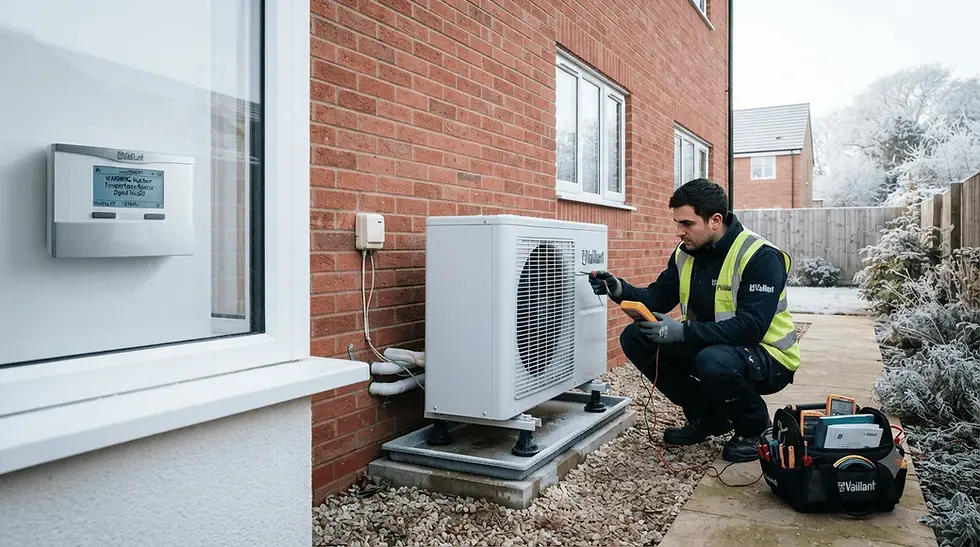
Why the Outdoor Temperature Sensor Is So Important
Many homeowners assume the outdoor temperature sensor simply tells them how cold it is outside.
In reality, it is one of the most influential sensors within the entire heat pump system.
Every few seconds, the controller uses the outdoor temperature reading to calculate how the heat pump should operate. This information directly influences the system's weather compensation strategy, allowing the heat pump to automatically adjust water temperatures based on changing outdoor conditions.
Without an accurate outdoor temperature signal, the system can no longer make intelligent operating decisions.
The outdoor temperature sensor helps the heat pump determine:
The correct flow temperature for current weather conditions
Compressor output and modulation levels
Heating efficiency throughout the day
Defrost cycle management during colder weather
Overall energy consumption
Indoor comfort and temperature stability
Long-term system performance
Because modern Vaillant heat pumps continuously optimize their operation using this data, even a small communication fault can significantly affect performance long before homeowners notice a complete loss of heating.
Why Vaillant Displays This Fault
The Outdoor Temperature Sensor Signal Invalid message is primarily a protective diagnostic warning, not confirmation that the heat pump has suffered a major failure.
Whenever the controller detects that the outdoor temperature reading is missing, inconsistent, or outside expected electrical values, it flags the signal as invalid.
This prevents the system from making heating decisions based on unreliable information.
Depending on the model and operating conditions, the heat pump may:
Continue operating with reduced functionality
Disable weather compensation
Switch to a default operating strategy
Display a warning until communication is restored
Require further investigation if the fault persists
In many situations, the fault is intermittent. The system may operate normally for several hours before losing communication again, making proper diagnostics far more valuable than repeatedly resetting the controller.
Professional Insight
As Vaillant Advance Master Tech engineers, one of the most common misconceptions we encounter is that this fault always means the outdoor sensor needs replacing.
In reality, the displayed error identifies the symptom, not the root cause.
A damaged cable, moisture inside a connector, corrosion on electrical terminals, poor continuity, or an intermittent communication fault can all generate exactly the same warning.
That is why experienced engineers focus on systematic diagnostics rather than replacing components based solely on the displayed fault code.
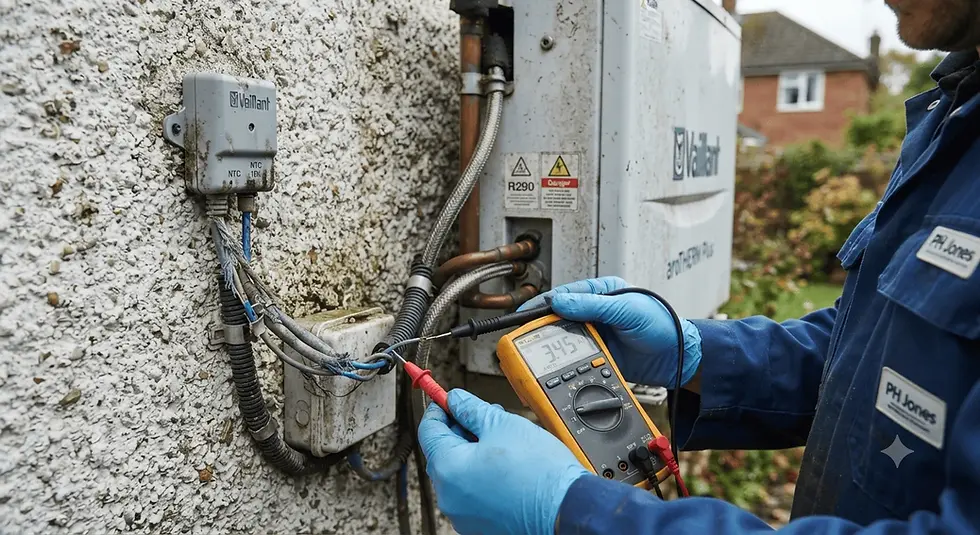
What Causes a Vaillant Outdoor Temperature Sensor Signal Invalid Fault?
Although the controller displays a single fault message, there is no single cause behind an Outdoor Temperature Sensor Signal Invalid error.
From an engineering perspective, the fault simply tells us that the heat pump cannot validate the outdoor temperature information it expects to receive. The actual problem could be anything from a loose electrical connection to a failed sensor or an intermittent control board issue.
This is why experienced engineers never replace parts based solely on the displayed fault code. Instead, they follow a structured diagnostic process to identify exactly where communication has failed.
Below are the most common causes encountered during professional fault investigations.
Damaged or Deteriorated Sensor Wiring
One of the most common reasons this fault appears is damage somewhere along the cable connecting the outdoor temperature sensor to the heat pump controller.
Unlike internal wiring, outdoor sensor cables remain exposed to changing weather conditions throughout the year. Continuous exposure to sunlight, rain, frost, wind, and temperature fluctuations gradually affects cable insulation and electrical connections.
Common wiring problems include:
UV-damaged cable insulation
Crushed or pinched cables
Loose terminal connections
Rodent damage
Garden equipment accidentally cutting cables
Moisture entering cable joints
Age-related deterioration
Even if the cable appears intact externally, an internal break or partially damaged conductor may interrupt communication only under certain conditions.
This often explains why some homeowners experience an intermittent fault that disappears after resetting the system before returning days or weeks later.
Outdoor Temperature Sensor Failure
Like any electronic component, the outdoor temperature sensor has a finite operating life.
Most Vaillant outdoor sensors contain a thermistor that changes electrical resistance as outdoor temperatures rise and fall. The control board continuously monitors these resistance values to determine the current ambient temperature.
If the thermistor becomes damaged or begins producing unstable readings, the controller may reject the signal entirely and display an Outdoor Temperature Sensor Signal Invalid fault.
Sensor failure may result from:
Natural component ageing
Internal moisture contamination
Manufacturing defects
Thermal stress from repeated seasonal temperature changes
Physical impact
Corrosion inside the sensor housing
Although sensor failure is a genuine possibility, professional engineers always verify the sensor through electrical testing before recommending replacement.
Loose Connections and Terminal Corrosion
Electrical connections are often overlooked because they appear secure during a quick visual inspection.
However, even a small amount of corrosion or a slightly loose terminal can interrupt the low-voltage signal travelling between the outdoor sensor and the controller.
Over time, outdoor environments expose electrical terminals to:
Condensation
Moisture
Oxidation
Temperature expansion and contraction
Airborne contaminants
These conditions gradually increase electrical resistance, causing intermittent communication faults that can be extremely difficult to reproduce during a service visit.
For this reason, connector inspection forms an important part of any professional diagnostic procedure.
Moisture Ingress
Water and electronic components rarely work well together.
If moisture enters the outdoor sensor housing, cable joints, or electrical connectors, signal quality can deteriorate significantly.
Possible sources of moisture include:
Damaged sensor enclosures
Failed cable seals
Heavy driving rain
Condensation
Ice formation during winter
Improperly sealed electrical connections
Initially, moisture may only affect communication occasionally.
As corrosion develops over time, intermittent faults often become permanent faults requiring component replacement.
Communication Circuit Problems
The outdoor sensor and indoor controller operate as part of a communication circuit.
If any section of that circuit becomes unstable, the controller may interpret the temperature signal as invalid even though the sensor itself remains fully functional.
Communication-related problems may involve:
Broken conductors
High electrical resistance
Connector faults
Electrical interference
Wiring continuity failures
Internal communication errors
Because communication problems can produce symptoms almost identical to sensor failure, systematic testing is essential before replacing any components.
Printed Circuit Board (PCB) Faults
Although relatively uncommon, faults within the heat pump's electronic control board can also generate an invalid outdoor temperature signal.
The PCB receives and processes information from multiple sensors throughout the heating system.
If the section responsible for interpreting outdoor temperature data becomes damaged, the controller may incorrectly report a sensor fault even when both the sensor and wiring remain in good condition.
Possible PCB-related causes include:
Failed electronic components
Damaged input circuits
Internal communication errors
Water damage
Voltage fluctuations
Manufacturing defects
Because PCB replacement can be expensive, engineers normally eliminate every other possible cause before considering the control board itself.
Incorrect Installation or Previous Repair Work
Not every fault develops naturally.
Some are introduced during installation, maintenance, or previous repair work.
Examples include:
Incorrect cable routing
Poor-quality electrical joints
Loose terminal screws
Incorrect sensor positioning
Damaged insulation during installation
Replacement sensors fitted incorrectly
These issues may not become apparent immediately.
The system can sometimes operate normally for months before vibration,
weather exposure, or normal ageing causes communication to deteriorate.
Whenever a fault appears shortly after installation or repair work, engineers will often review the quality of previous workmanship as part of the diagnostic process.
Environmental Factors
Outdoor sensors are specifically designed to withstand harsh weather, but years of environmental exposure inevitably take their toll.
Conditions that may contribute to sensor or wiring deterioration include:
Prolonged ultraviolet (UV) exposure
Repeated freezing and thawing
Heavy rainfall
Wind-driven moisture
Snow and ice accumulation
Coastal salt exposure
Air pollution
Storm damage
While these conditions rarely trigger an immediate fault, they can gradually weaken components until communication becomes unreliable.
Regular servicing often identifies early signs of deterioration before a complete failure occurs.

Why Intermittent Faults Are Often the Most Difficult to Diagnose
One of the biggest frustrations for both homeowners and engineers is an error that appears one day, disappears after a reset, and then returns without warning.
Intermittent faults are particularly challenging because the system may operate perfectly while the engineer is on site.
In many cases, the fault only occurs when specific conditions combine, such as:
Cold overnight temperatures
High humidity
Heavy rainfall
Thermal expansion of wiring
Compressor start-up
Defrost operation
Electrical vibration during normal running
Without a structured diagnostic process, replacing parts based on assumptions can become both expensive and ineffective.
This is why professional engineers often analyze fault history, operating conditions, electrical measurements, and sensor performance together before reaching a final diagnosis.
Professional Insight
As Vaillant Advance Master Tech engineers, we rarely assume the displayed fault identifies the failed component.
Instead, we ask a different question:
Why has the controller stopped trusting the outdoor temperature signal?
The answer may be a damaged sensor—but it could just as easily be a loose connector, deteriorating cable, intermittent communication fault, moisture ingress, or an electrical issue elsewhere within the system.
Understanding this distinction is the key to accurate diagnosis, preventing unnecessary part replacements, and restoring reliable heat pump performance.
Is It Safe to Continue Running Your Heat Pump?
When the Outdoor Temperature Sensor Signal Invalid fault appears, one of the first questions homeowners ask is:
"Can I keep using my heat pump until someone looks at it?"
The answer depends on how the system responds to the fault.
Unlike some faults that immediately stop all operation, an outdoor temperature sensor communication error may allow the heat pump to continue running under limited conditions. Some models enter a protective operating mode, while others suspend weather compensation or reduce heating performance until a valid outdoor temperature signal is restored.
Although your home may still receive heating or hot water for a period of time, continuing to rely on a system with an unresolved sensor fault is not recommended.
The outdoor temperature sensor plays an important role in helping the heat pump calculate efficient operating temperatures. Without reliable outdoor temperature data, the controller may no longer optimize energy consumption or heating performance correctly.
Ignoring the warning can result in:
Reduced heating efficiency
Higher electricity consumption
Less accurate room temperatures
Poor weather compensation performance
Increased wear caused by inefficient operation
Recurring fault messages
While the fault itself is not usually dangerous, allowing it to remain unresolved may reduce the overall performance and reliability of your heating system.
Can Homeowners Fix an Outdoor Temperature Sensor Signal Invalid Fault?
Some basic checks can safely be carried out by homeowners.
However, diagnosing the actual cause of the fault requires a clear understanding of low-voltage electrical circuits, electronic sensors, and heat pump control systems.
Think of the displayed fault code as a warning light rather than a diagnosis.
Just as a dashboard warning on a car doesn't identify the exact failed component, this error simply tells you the controller has stopped receiving reliable outdoor temperature information.
The objective is to determine why that has happened.
In some situations, the issue may be something simple.
In others, professional testing will be required.
Safe Checks Homeowners Can Carry Out
Before arranging a service visit, there are several visual inspections that can safely be completed without opening the heat pump or exposing electrical components.
These checks will not repair the fault, but they may help identify obvious external issues.
Check the Outdoor Sensor
Locate the outdoor temperature sensor if it is visible on your installation.
Look for signs of:
Physical damage
Cracked sensor housing
Loose mounting brackets
Impact damage
Excessive dirt or debris
Signs of water entering the enclosure
If the sensor appears damaged, avoid attempting to dismantle or repair it yourself.
Inspect Visible Wiring
Follow any accessible sensor cable as far as it can be safely seen.
Check for:
Frayed insulation
Crushed cable
Rodent damage
Loose clips
Signs of weather deterioration
Accidental damage from gardening equipment
Never pull, disconnect, or test electrical wiring.
A simple visual inspection is sufficient.
Check for Recent Work
Consider whether anything has recently changed.
For example:
Recent servicing
Building work
Landscaping
Pressure washing
Electrical work
Storm damage
Sometimes a previously reliable system begins displaying faults after external work has disturbed sensor wiring or connectors.
Look for Obvious Environmental Damage
Extreme weather can occasionally affect exposed external components.
Inspect the surrounding area for:
Fallen branches
Ice accumulation
Impact damage
Flooding
Animal interference
While these issues are uncommon, they can occasionally explain a sudden communication fault.
What Homeowners Should NOT Attempt
Modern heat pumps contain sophisticated electronics that should only be serviced by trained professionals.
Attempting repairs without appropriate knowledge can increase repair costs, create electrical hazards, and may invalidate manufacturer warranties.
Avoid attempting the following:
Opening the indoor or outdoor unit casing
Disconnecting electrical wiring
Testing cables with electrical equipment
Replacing the outdoor temperature sensor
Removing the control board
Altering installer settings
Bypassing safety devices
Carrying out electrical continuity tests
These procedures require specialist equipment, technical documentation, and safe isolation procedures.
Why Professional Testing Is Different
Professional engineers do far more than confirm whether the sensor is working.
A complete diagnostic investigation may include:
Reviewing stored fault history
Measuring sensor resistance values
Testing wiring continuity
Inspecting connectors for corrosion
Verifying communication between the sensor and controller
Checking PCB inputs
Confirming sensor calibration
Monitoring live operating data
This structured approach helps identify the true source of the fault rather than replacing components through trial and error.
How to Reset a Vaillant Outdoor Temperature Sensor Signal Invalid Fault
Many homeowners search for a reset because they hope the warning has been caused by a temporary software glitch.
In some cases, that assumption is correct.
Brief interruptions caused by electrical disturbances or temporary communication errors may occasionally clear after restarting the system.
However, it is important to understand that resetting the heat pump does not repair the underlying cause of the fault.
If damaged wiring, a failed sensor, or a communication problem remains present, the warning will almost certainly return.
Method 1: Reset Using the Controller
Depending on your Vaillant heat pump model and controller version, you may be able to reset the fault directly from the user interface.
This generally involves:
Following the on-screen reset option if available.
Confirming the reset request.
Allowing the heat pump to complete its startup sequence.
Monitoring the system to see whether the fault reappears.
Always follow the operating instructions supplied with your specific Vaillant controller.
Method 2: Perform a Safe Power Cycle
If the controller reset does not clear the warning, a complete power cycle may resolve a temporary communication interruption.
A typical procedure involves:
Switching the heat pump off using the external electrical isolator.
Leaving the system powered down for approximately 10 minutes.
Restoring the electrical supply.
Allowing the controller to complete its normal startup process.
This gives the control electronics time to fully reset and re-establish communication with connected sensors.
When a Reset May Be Successful
A reset is most likely to work when the fault has been caused by:
A temporary communication interruption
A short-term software anomaly
Electrical interference
A brief power fluctuation
These situations are relatively uncommon but can occur occasionally.
Why the Fault Often Returns After Resetting
One of the most common mistakes homeowners make is assuming the problem has been solved simply because the warning disappears.
In reality, the controller has only restarted.
It has not repaired damaged wiring, dried moisture inside a connector, corrected a faulty sensor, or restored a deteriorating electrical connection.
As soon as the controller receives another invalid temperature signal, the fault will return.
This explains why many homeowners experience the same warning repeatedly over several days or weeks before arranging a professional inspection.
Repeated resets should never be viewed as a long-term solution.
Instead, they should be treated as evidence that the underlying fault still exists.
When Should You Stop Resetting the System?
A single successful reset after an isolated power interruption is not usually a cause for concern.
However, if the warning returns, continuing to reset the heat pump is unlikely to resolve the issue.
Professional investigation is recommended if:
The same fault returns more than once.
Heating performance becomes inconsistent.
The controller displays additional fault messages.
The heat pump repeatedly enters protective mode.
Hot water production becomes unreliable.
The system behaves differently during cold weather.
These symptoms usually indicate an underlying problem that requires proper diagnosis rather than repeated system restarts.
Professional Insight
As Vaillant Advance Master Tech engineers, we rarely arrive at a property where the fault has appeared only once.
More commonly, homeowners have reset the system several times over a period of days or even weeks, hoping the problem has disappeared because the heating temporarily returns.
In many cases, each reset simply delays identifying the real issue. Whether the cause is a deteriorating sensor, moisture inside a connector, damaged wiring, or an intermittent communication fault, the controller will continue reporting the error until the root cause is corrected.
Our advice is straightforward:
Use a reset to rule out a temporary electronic interruption—not as a substitute for professional diagnosis. A recurring outdoor temperature sensor fault is the heat pump's way of telling you that something within the communication circuit requires attention.
When a Reset Doesn't Solve the Problem
Many homeowners feel relieved when the fault code disappears after pressing the reset button or performing a power cycle.
Unfortunately, that relief is often temporary.
If the Outdoor Temperature Sensor Signal Invalid error returns hours or days later, the system is telling you that an underlying fault still exists.
The reset simply clears the alarm—it does not repair damaged wiring, restore sensor communication, or fix an electronic component that has failed.
This is why professional engineers treat recurring sensor faults very differently from a one-time communication error.
Rather than repeatedly resetting the heat pump, the goal is to identify why the outdoor temperature signal is being lost in the first place.
Why the Fault Keeps Returning
A recurring outdoor temperature sensor fault usually points to an intermittent problem.
Unlike a completely failed component, intermittent faults can disappear temporarily before returning under certain operating conditions.
Experienced engineers commonly investigate:
Loose electrical connections
Moisture inside connectors
Cable damage caused by weather exposure
Corrosion within terminals
Damaged sensor wiring
Failing outdoor temperature sensor
PCB communication faults
Electrical interference
Sometimes the heat pump may operate perfectly during the day before displaying the fault overnight.
In other cases, the system only loses communication during periods of heavy rain, freezing temperatures, or rapid temperature changes.
These patterns provide valuable clues during diagnostics.
Why Accurate Outdoor Temperature Readings Matter
Many homeowners assume the outdoor temperature sensor is simply a thermometer.
In reality, it is one of the most important sensors within the entire heat pump system.
Every few seconds, the controller uses the outdoor temperature reading to calculate how much heat your property requires.
This information influences:
Weather compensation
Flow temperature
Compressor output
Defrost timing
Energy consumption
Heating efficiency
Overall system performance
Without accurate outdoor temperature data, the heat pump cannot optimize its operation correctly.
Instead, it may switch into a protective operating mode, stop heating completely, or generate an Outdoor Temperature Sensor Signal Invalid fault.
How Professional Engineers Diagnose the Fault
One of the biggest misconceptions surrounding sensor errors is that replacing the sensor always fixes the problem.
In reality, professional diagnosis follows a structured process designed to identify the true root cause before any components are replaced.
A typical diagnostic investigation may include:
Reviewing Fault History
Engineers first access the controller's diagnostic history to determine:
When the fault first appeared
Whether it occurs intermittently
Whether it appears during heating, hot water, or standby mode
Whether additional fault codes accompany the sensor error
Fault history often provides the first indication of where to begin testing.
Inspecting the Outdoor Sensor
The outdoor sensor is carefully examined for:
Physical damage
Cracked housing
Water ingress
Loose mounting
UV deterioration
Impact damage
Even a small crack can allow moisture to enter the sensor and cause unreliable readings.
Testing Sensor Resistance
Outdoor temperature sensors use a thermistor whose electrical resistance changes as temperature changes.
Using specialist equipment, engineers compare the measured resistance against manufacturer specifications.
If readings fall outside acceptable tolerances, the sensor is likely defective.
Checking Cable Continuity
The wiring between the outdoor sensor and indoor control unit is tested for:
Open circuits
Short circuits
High resistance
Loose terminals
Damaged insulation
Cable faults are among the most common causes of recurring communication errors.
Inspecting Connectors
Outdoor electrical connections are exposed to:
Rain
Frost
Condensation
Temperature fluctuations
UV exposure
Over time, connectors may develop:
Corrosion
Oxidation
Moisture contamination
Loose contacts
Cleaning or replacing damaged connectors often restores reliable communication.
Evaluating the PCB
If the sensor and wiring both test correctly, attention turns to the main control board.
Engineers may assess:
Communication circuits
Voltage supply
Signal processing
Internal PCB faults
Firmware behaviour
PCB issues are less common but remain a possible cause of persistent Outdoor Temperature Sensor Signal Invalid errors.

Real-World Example: Diagnosing an Outdoor Temperature Sensor Fault
Understanding how this fault is diagnosed in practice helps explain why replacing random parts rarely solves the problem.
The Property
Property Type:
Four-bedroom detached home
Heating System:
Vaillant air source heat pump
Underfloor heating
Domestic hot water cylinder
Reported Fault:
Outdoor Temperature Sensor Signal Invalid
Heating stopped overnight
Error cleared after reset
Fault returned several days later
Initial Assumption
The homeowner believed the outdoor temperature sensor itself had failed and was preparing to order a replacement.
However, professional diagnostics told a different story.
Diagnostic Investigation
The engineer performed:
Fault history review
Sensor resistance testing
Cable continuity testing
Connector inspection
PCB communication checks
The outdoor sensor tested perfectly.
Instead, the investigation revealed moisture inside an external electrical
connector where rainwater had slowly entered over time.
As temperatures dropped overnight, condensation affected the electrical connection and interrupted communication between the sensor and controller.
The Repair
The repair involved:
Replacing the damaged connector
Cleaning affected terminals
Resealing the cable entry
Verifying communication stability
Testing weather compensation
No new sensor was required.
No PCB replacement was required.
Once the connector was repaired, the fault disappeared completely.
The Key Lesson
The displayed fault suggested a sensor problem.
The actual cause was a deteriorated electrical connection.
This illustrates why professional diagnostics focus on identifying the underlying fault rather than replacing parts based solely on the error message.
How to Help Prevent Outdoor Temperature Sensor Faults
Although electronic faults cannot always be avoided, routine maintenance significantly reduces the likelihood of communication problems developing over time.
Simple preventative measures include:
Schedule Regular Heat Pump Servicing
During professional servicing, engineers may inspect:
Sensor operation
External wiring
Electrical connectors
Controller software
Weather compensation settings
Overall system performance
Early identification of deteriorating components often prevents unexpected breakdowns during winter.
Prevent unexpected sensor faults before they interrupt your heating. Our professional heat pump servicing includes electrical inspections, sensor checks, and performance testing to help keep your system operating reliably throughout the year.
Keep Outdoor Components Protected
Avoid allowing:
Garden equipment
Climbing plants
Pressure washers
DIY modifications
to damage cables or sensor housings.
Even minor physical damage can eventually lead to moisture ingress.
Report Intermittent Faults Early
If an error appears occasionally before disappearing, avoid assuming it has fixed itself.
Intermittent faults often become more frequent over time.
Early diagnosis usually results in:
Lower repair costs
Faster repairs
Reduced downtime
Improved system reliability
When Should You Call a Vaillant Advance Engineer?
Professional assistance is recommended if:
The fault returns after resetting.
Heating stops repeatedly.
Hot water production becomes unreliable.
Multiple fault codes appear together.
The outdoor sensor or wiring appears damaged.
The heat pump enters protection mode frequently.
The controller displays inconsistent outdoor temperatures.
Attempting further electrical investigation without appropriate training is not recommended.
Modern heat pumps contain high-voltage electrical components and sophisticated control systems that require specialist knowledge and test equipment.
Can an Outdoor Temperature Sensor Signal Invalid Fault Damage Your Heat Pump?
One of the first questions homeowners ask after seeing this fault is whether continuing to use the heat pump could cause permanent damage.
In most cases, the answer is not immediately.
Modern Vaillant heat pumps are designed with multiple safety mechanisms that prevent operation when critical sensor data becomes unreliable. If the controller cannot accurately determine the outdoor temperature, it may enter a protective mode, reduce system performance, or stop operating altogether.
However, repeatedly resetting the fault without addressing the underlying issue is not recommended.
If the problem stems from deteriorating wiring, moisture ingress, or an intermittent electrical fault, repeated operation may lead to:
Unexpected heating interruptions
Reduced energy efficiency
Inaccurate weather compensation
Increased compressor cycling
Greater wear on electrical components
The fault itself is designed to protect the system. Ignoring it simply delays identifying the real cause.
How Much Does It Cost to Repair an Outdoor Temperature Sensor Fault?
One of the most common searches after seeing this error is:
"How much will this repair cost?"
Unfortunately, there is no fixed answer because the displayed fault code identifies a communication problem rather than a specific failed component.
Repair costs depend entirely on what engineers discover during diagnosis.
Lower-Complexity Repairs
Some faults can be resolved by correcting relatively simple issues such as:
Loose electrical connectors
Minor wiring defects
Corroded terminals
Moisture contamination
Controller reset and recommissioning
These issues generally require less time than replacing major components.
Moderate Repairs
More involved repairs may include:
Outdoor temperature sensor replacement
Cable replacement
Connector replacement
Controller recalibration
Communication circuit repairs
These typically require additional diagnostic testing before replacement work begins.
Less Common Repairs
Although uncommon, engineers may occasionally identify:
PCB communication faults
Internal control board failures
Extensive cable damage
Installation-related wiring defects
These situations require specialist investigation because replacing parts without confirming the fault often increases repair costs unnecessarily.
Why Professional Diagnosis Saves Money
Many homeowners understandably assume the displayed error identifies the failed component.
In reality, fault codes identify symptoms—not necessarily the cause.
For example, a controller displaying Outdoor Temperature Sensor Signal Invalid may actually be suffering from:
A loose connector
Moisture inside a junction box
Damaged cable insulation
Electrical interference
Poor terminal connections
Replacing the outdoor sensor without confirming the fault may leave the original problem unresolved.
Professional diagnostics reduce unnecessary parts replacement by identifying the true source of the communication failure before repairs begin.
Frequently Asked Questions
What Does "Outdoor Temperature Sensor Signal Invalid" Mean on a Vaillant Heat Pump?
This message means the heat pump's controller can no longer receive a reliable outdoor temperature reading from the external sensor. Because outdoor temperature directly influences weather compensation, flow temperature, and compressor operation, the system may enter a protective mode until valid data is restored. The fault does not automatically mean the sensor has failed—it may also be caused by damaged wiring, poor electrical connections, moisture ingress, or communication problems that require systematic diagnosis.
Why Is My Vaillant Heat Pump Showing an Outdoor Temperature Sensor Signal Invalid Error?
The error usually appears when communication between the outdoor temperature sensor and the controller is interrupted or when the sensor reports an implausible reading. Common causes include damaged cables, loose terminals, corrosion, moisture inside electrical connectors, failed thermistors, or less commonly, a control board fault. Because several different issues can trigger the same message, professional testing is normally required before replacing any components.
Can I Reset an Outdoor Temperature Sensor Signal Invalid Fault Myself?
Yes. Homeowners can usually perform a basic controller reset or safely isolate power using the manufacturer's recommended procedure. If the fault resulted from a temporary electronic glitch, the system may restart normally. However, if the error returns shortly afterwards, resetting alone will not resolve the underlying problem. Repeated resets should never replace proper diagnosis, particularly if heating performance continues to be affected.
Where Is the Outdoor Temperature Sensor Located?
The outdoor temperature sensor is normally mounted on or near the outdoor unit where it can accurately measure external air temperature without being influenced by direct sunlight or nearby heat sources. Its exact position varies between installations and models. Because it forms part of the heat pump's electrical control system, homeowners should avoid dismantling the sensor housing or attempting internal electrical repairs themselves.
Can Bad Weather Cause This Fault?
Extreme weather rarely damages the sensor directly, but prolonged exposure to heavy rain, snow, ice, condensation, or freezing temperatures can contribute to connector corrosion or moisture ingress over time. Storm damage may also affect exposed cabling. Professional inspections often include checking weatherproof seals, cable entries, and external connectors to ensure environmental conditions have not compromised communication between the sensor and controller.
Is It Safe to Keep Resetting the Error?
Occasionally resetting the controller is unlikely to cause immediate harm, but repeatedly clearing the same fault without investigation is not recommended. If communication continues to fail, the heat pump may operate inefficiently or repeatedly shut down, leading to unnecessary wear and unreliable heating. A recurring sensor fault should always be treated as an indication that further investigation is required rather than a problem that will disappear permanently.
Can a Faulty Outdoor Temperature Sensor Affect Heating Performance?
Yes. The outdoor temperature sensor plays a central role in weather compensation, allowing the controller to adjust flow temperatures according to outdoor conditions. If the sensor provides inaccurate information or loses communication completely, the system may produce insufficient heating, operate less efficiently, cycle more frequently, or stop operating until valid temperature data becomes available again.
Can Damaged Wiring Cause This Error?
Absolutely. Wiring problems remain one of the most common causes of recurring outdoor temperature sensor faults. Damage caused by age, weather exposure, rodents, accidental impact, or loose terminals can interrupt communication between the outdoor sensor and the indoor controller. Engineers normally perform continuity testing before replacing the sensor because wiring faults often produce identical symptoms.
Does This Fault Mean the Outdoor Sensor Needs Replacing?
Not necessarily. Although a failed sensor is one possible cause, many recurring faults are ultimately traced to loose electrical connections, damaged cables, moisture contamination, or communication issues elsewhere within the control circuit. Replacing the sensor without confirming the diagnosis may increase repair costs while leaving the original fault unresolved.
Will My Heat Pump Stop Working Completely?
Many Vaillant systems enter a protective operating mode when outdoor temperature information becomes unavailable. Depending on the model and system configuration, heating performance may be reduced or stopped until reliable sensor communication is restored. This protective response helps prevent inefficient operation rather than indicating catastrophic system failure.
How Do Engineers Diagnose This Fault?
Professional diagnosis usually involves reviewing fault history, measuring sensor resistance, testing cable continuity, inspecting connectors for corrosion or moisture, verifying voltage supplies, and assessing PCB communication. This structured process allows engineers to identify whether the fault originates from the sensor itself, the wiring, or the control electronics, helping avoid unnecessary replacement of functioning components.
Can Moisture Cause Outdoor Temperature Sensor Problems?
Yes. Moisture is a frequent contributor to intermittent communication faults, particularly where external connectors or cable entries have deteriorated over time. Water ingress can create corrosion, unstable electrical resistance, or temporary communication interruptions that become more noticeable during wet or freezing weather. Proper sealing and routine inspections help reduce this risk.
How Can I Prevent This Fault from Returning?
Routine servicing is the most effective way to reduce the likelihood of recurring sensor communication faults. During annual maintenance, engineers can inspect external wiring, check connector condition, verify sensor readings, update controller settings where appropriate, and identify early signs of deterioration before they develop into unexpected breakdowns during colder months.
Should I Call an Engineer if the Error Keeps Returning?
Yes. A fault that repeatedly returns after resetting almost always indicates an unresolved electrical or communication issue. Continued operation without investigation may lead to unreliable heating performance and additional wear on system components. Professional diagnosis identifies the underlying cause and helps restore reliable operation without unnecessary parts replacement.
Does This Fault Affect Weather Compensation?
Yes. Weather compensation relies on accurate outdoor temperature readings to calculate the most efficient flow temperature for your home. If the controller loses this information, it can no longer optimize heating output correctly. As a result, the system may reduce efficiency, operate less consistently, or enter a protective mode until reliable outdoor temperature data becomes available again.
Key Takeaways
An Outdoor Temperature Sensor Signal Invalid fault usually indicates lost or unreliable communication between the outdoor sensor and the heat pump controller.
Damaged wiring, moisture ingress, loose connectors, and failed sensors are among the most common causes.
A reset may temporarily clear the error, but recurring faults normally require professional investigation.
Accurate outdoor temperature readings are essential for weather compensation, heating efficiency, and reliable system operation.
Structured diagnostics help identify the true cause before unnecessary parts are replaced.
Conclusion
A Vaillant Outdoor Temperature Sensor Signal Invalid fault can appear alarming, particularly when your heating or hot water suddenly stops working. However, the error should be viewed as the beginning of the diagnostic process rather than the final diagnosis.
In many cases, the problem lies not with the outdoor sensor itself but with damaged wiring, poor electrical connections, moisture ingress, or communication issues elsewhere within the control system. Simply replacing components without confirming the root cause often increases repair costs while failing to resolve the issue permanently.
If the fault appears once and clears successfully, continue monitoring the system. If it returns repeatedly, professional diagnostics provide the safest and most effective route to restoring reliable, efficient operation.
Need Help Diagnosing a Vaillant Outdoor Temperature Sensor Fault?
If your heat pump continues displaying an Outdoor Temperature Sensor Signal Invalid error after resetting, professional diagnostics can identify the real cause before unnecessary parts are replaced.
Our experienced engineers investigate the complete communication circuit, including:
Outdoor sensor testing
Wiring inspections
Electrical continuity checks
Connector assessments
PCB diagnostics
Weather compensation verification
Performance optimization
Rather than guessing, we focus on finding the underlying fault and restoring reliable heat pump performance.
Book your professional heat pump diagnostic today and let our specialists identify the problem correctly the first time.
About Air Source Company
My Air Source Company Limited is a Nottingham-based renewable heating specialist focused on the design, installation, servicing, diagnostics, repair, and optimization of air source heat pump systems for residential and commercial properties across the Midlands and surrounding areas.
As an MCS Certified, TrustMark Registered, and RECC Member business, Air Source Company is also recognized as a Daikin Approved Installer and Vaillant Advance Master Tech installer. The company provides engineering-led heating solutions, including heat loss calculations, bespoke system design, preventative maintenance, fault diagnosis, performance optimization, underfloor heating integration, and support for government initiatives such as the Boiler Upgrade Scheme (BUS).
Every project is designed around the property's heating requirements, insulation levels, occupancy patterns, and long-term energy goals. By combining technical expertise with practical system design, Air Source Company helps homeowners and businesses improve comfort, reduce running costs, maximize seasonal efficiency, and maintain reliable low-carbon heating throughout the year.
Whether installing a new air source heat pump, diagnosing a complex fault, or optimizing an existing renewable heating system, the company's focus is on delivering technically sound, compliant, and energy-efficient solutions tailored to UK conditions.
About the Author
Ash Sethi is the founder of My Air Source Company Limited and leads the company's technical content on air source heat pumps, renewable heating systems, and energy-efficient home heating.
His work focuses on translating complex heating concepts into practical guidance for UK homeowners, property managers, and businesses. The articles published by Air Source Company are based on recognized industry guidance, manufacturer documentation, current UK regulations, and the company's practical experience in designing, installing, servicing, and diagnosing air source heat pump systems.
Topics covered include heat pump performance, fault diagnosis, system optimization, maintenance, energy efficiency, government grant schemes, planning requirements, and best practices for renewable heating installations. Each guide is written to provide accurate, technically informed, and homeowner-friendly information that supports better decision-making and long-term system performance.
Technical References
This guide is based on recognized industry guidance, manufacturer documentation, and professional diagnostic practices, including:
Manufacturer commissioning and maintenance procedures
Diagnostic methods may vary depending on heat pump model, controller version, installation design, and system configuration.


Comments